
Feature price and bet value: which is truly deducted from the balance?
If a paid entry has a price of 100× the bet value of 2, the displayed price is 200, not 2. Read the total confirmed charge and record it separately in the feature return.

There is a small bet value below the reels and a larger price in the feature panel. They have the same number, but different jobs: one is the basis of the calculation and the other is the cost of the specific action. When only the first number is entered in the session note, the incorrectly recorded cost will be reduced.
In this guide, we will separate the price, confirmed debit and award. It is related to slots topic in crazywin homepage. Not all games or operators have paid entry; the discussion is for reading the condition if there is such an option.
100× may be a cost multiplier, not a reward multiplier
There is a real example of this way of writing: sa Pragmatic Play announcement on 12 May 2022 for Goblin Heist PowerNudge, mentions Buy Free Spins worth 100× the bet in some jurisdictions. This is a historical example of a price expression. It does not confirm the current price, configuration or availability with a Philippine operator.
In own sample panel, set the base value at 2 units and the full entry price at 100 × 2 = 200 units. Also assume there is no separate ordinary spin or fee in this action. In that case, the debit is 200: not 2, not 100, and not 202. The extra 2 would be double the number if the price of 200 already included the entire action.
When there is a separate charge in the actual confirmation, include that according to the record. It is not a general rule that there is no other charge; that’s just a condition of the example. A clear total before confirming the action is more important than a guess made from a label.
If the base is changed from 2 to 3 while the 100× multiplier is the same, the price will be 300 in this model. One unit is added to the base, but 100 units are added to the entry cost. So the total price needs to be read again after changing the setting.
Same feature return, three different cost records
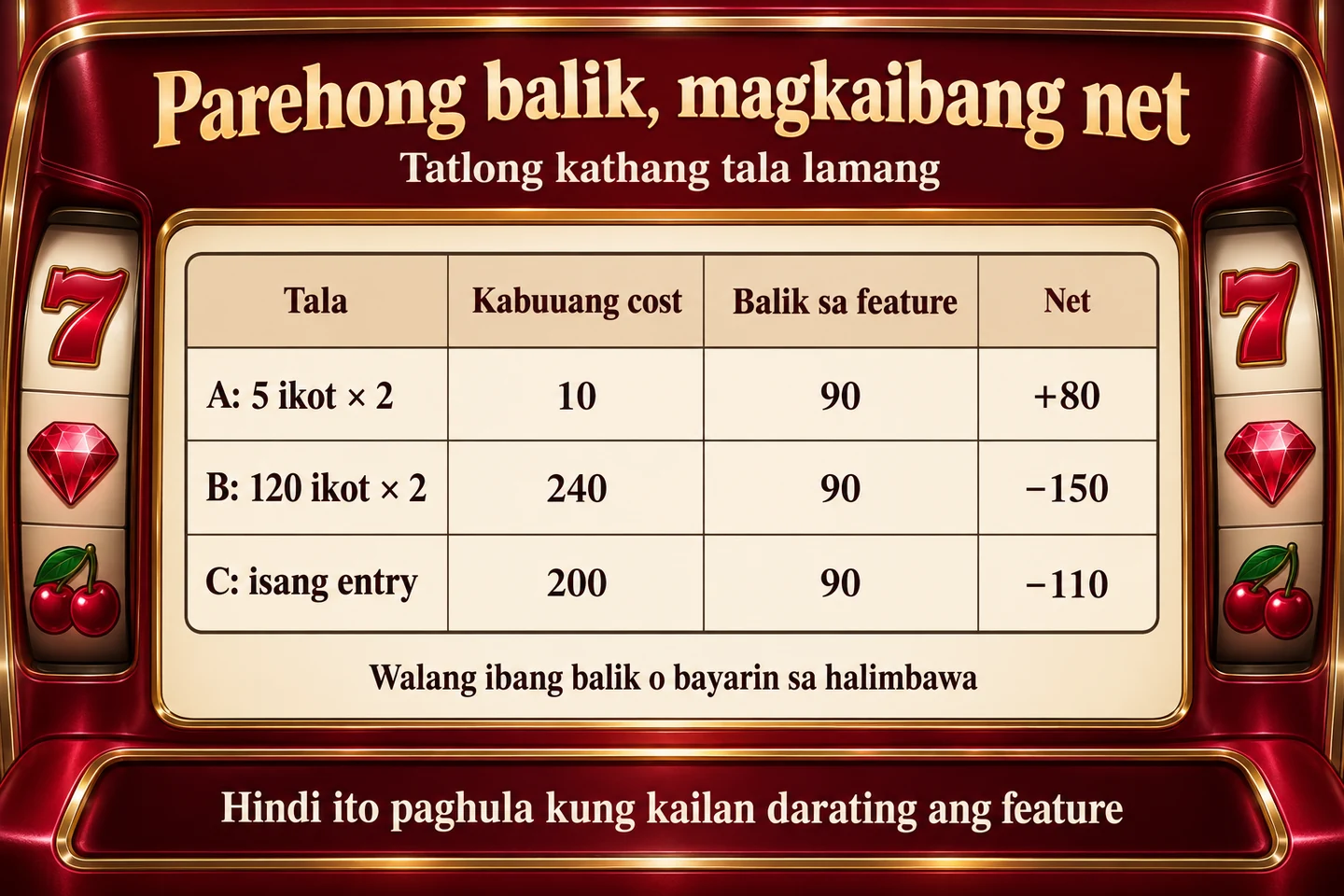
The three notes below are fictional separate histories, not test results and not three steps that need to be done. The starting balance is equal to 300 units and the total feature return is 90 units. In A and B, each paid spin is 2 units, other base-game returns are zero, and there are no other fees, deposits or withdrawals. In C, a full entry costs only 200.
| note | Cost until the feature ends | Total return | Net | Final balance |
|---|---|---|---|---|
| A: natural trigger on the 5th paid spin | 5 × 2 = 10 | 90 | 90 − 10 = +80 | 300 − 10 + 90 = 380 |
| B: natural trigger on the 120th paid spin | 120 × 2 = 240 | 90 | 90 − 240 = −150 | 300 − 240 + 90 = 150 |
| C: a paid entry | 100 × 2 = 200 | 90 | 90 − 200 = −110 | 300 − 200 + 90 = 190 |
A number of 5 or 120 includes the spin that triggers the feature. There is no separate per-spin charge within the feature in the example set. If the actual mechanics are different, the worksheet needs to be changed according to the records.
When only A and C are shown, the cost of the natural trigger appears to be lower. When B and C, the comparison is reversed. This does not prove that it is better to choose either. Only three fictional histories were chosen and their probability is not known here. There is no basis to say that the feature will come on the 5th or 120th spin, or that it will come before a limit is exhausted.
The feature win screen is not full session results
In C, 90 is return and −110 is net. “Profit 90” would be wrong because 200 has not been deducted. 90 − 2 = 88 would also be wrong if ordinary bet value was used instead of confirmed entry cost.
A remaining-spin counter is another separate record: the retrigger worksheet accounts for a used spin and an added award without treating either as money won.
If there are separate win components in the history, first determine if they are already included in the total of 90. Do not add the total back to its own components. For reading reward records, open the award and pool topic; the type of record and its rule must be followed.
The total session note may also have other paid actions and returns before or after the feature. In the actual record, select the clear start and end of the range. One winning screenshot is not enough to compare the entire session to another session.
Checklist before making a cost comparison
- Match the title, variant and entry type. Separate natural trigger, paid entry and any other optional mode. Do not transfer the price from another game.
- Write the unit and base. If the price is a multiplier, find out what amount is being multiplied. Is it cash, credits or another unit?
- Read the total charge. Is there a separate fee or action? Avoid adding the amount already included in the total.
- See the applicable feature rules. The feature configuration is not automatically the same because the screen name is the same.
- Then, use the confirmed history. Separate request, debit and settled return. When the record is missing, clarify with the operator first before repeating the action.
Emphasizes the UK Gambling Commission RTS 2 the clear amount and content of the transaction, including the unit and total stake if applicable. This standard is in the scope of regulation in Great Britain; this is not a description of the Philippine licensing status of the site or a guarantee of the interface of any operator.
Frequently interchangeable
If the name is “free spins”, is the entire entry free?
The name is not enough to know the entry cost. In a paid-entry example, there is a charge before the feature starts even though there is no extra per-spin charge in it.
Is a better return expected when buying a feature?
The cost multiplier doesn’t answer that. Applicable game mathematics and feature configuration are required; the three fake histories here are not evidence of the expected return.
Once the set limit is reached, should it continue to trigger?
There is no trigger schedule that proves the example. Upfront costs are no reason to chase the feature. There is a separate one guide to limits and support.
For other topics, see library of guides. Both sources were checked on 4 October 2026; the 2022 announcement is used only as of its date. The prices, history and balance in the worksheet are self-made examples. For 21+ readers; no actual purchase or gameplay performed.