
Lotto odd and even numbers: a common pattern is not a better ticket
A lottery pattern can contain many possible results while the particular combination on your ticket still covers just one. That is why “three odd and three even” being a common six-number pattern does not make every combination with that pattern more likely than another exact combination in a fair draw.
This guide in the crazywin lottery section separates a pattern from the numbers it contains. It is a counting explanation, with a small fictional draw you can check yourself. The sample numbers are not recommendations or current results.
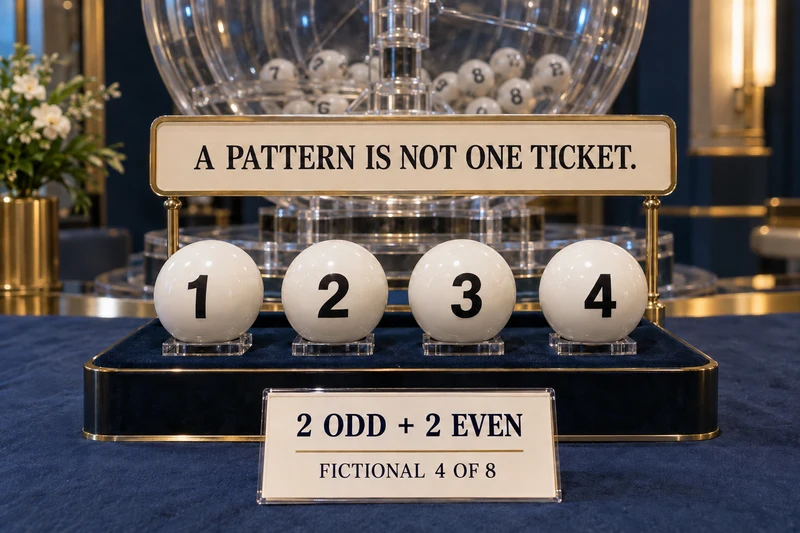
One label can describe many different results
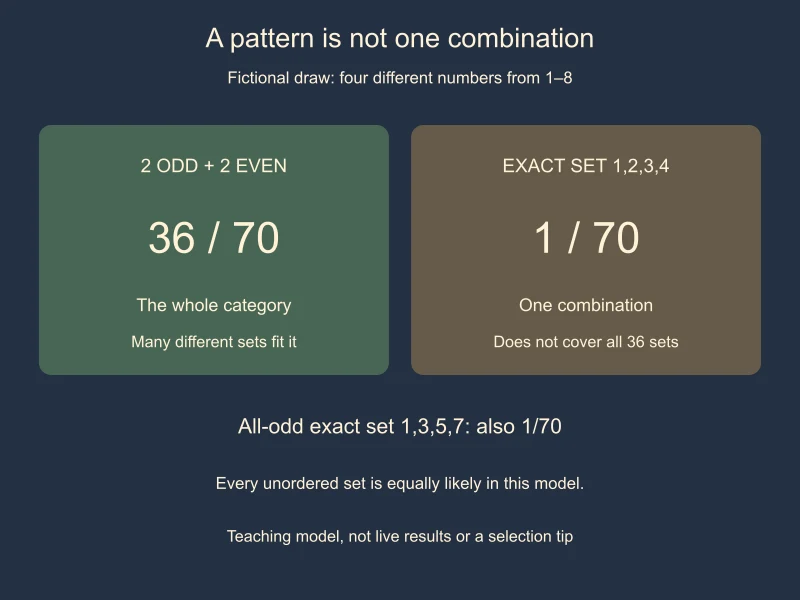
Consider a fictional draw that selects four different numbers from 1 through 8. Order does not matter, and we assume every possible four-number set has the same chance. There are 70 sets in total. Four available numbers are odd—1,3,5,7—and four are even—2,4,6,8.
The set 1,2,3,4 has two odd and two even numbers. So does 1,2,5,6. They share a pattern, but they are different results. A ticket containing 1,2,3,4 does not also contain 1,2,5,6 merely because both look balanced.
| Question in the fictional draw | Sets counted | Probability under the stated fair model |
|---|---|---|
| Does the result have two odd and two even numbers? | 36 | 36/70, about 51.43% |
| Is the exact result 1,2,3,4? | 1 | 1/70, about 1.43% |
| Is the exact result 1,3,5,7? | 1 | 1/70, about 1.43% |
The last row looks unusual because all four numbers are odd. Yet that one exact set has the same probability as the one balanced set in the row above. The difference is that the balanced category contains 36 sets, while the all-odd category contains only one in this small model.
Where do the 36 balanced sets come from?
There are six ways to choose two of the four odd numbers:1/3,1/5,1/7,3/5,3/7 and 5/7. There are also six ways to choose two of the four even numbers. Combining one odd pair with one even pair gives 6×6=36 distinct four-number sets.
Counting all the patterns gives 1 all-even set,16 sets with one odd number,36 with two odd numbers,16 with three odd numbers, and 1 all-odd set. Their total is 70. This is an enumeration of a fictional sample space, not a tally of real past draws.
What changes in a six-from 42 format?
The PCSO LottoMatik Lotto 6/42 selection screen, checked 10 October 2026, shows a standard selection of six numbers with available values 01 through 42. That establishes the format used for the larger illustration here; it does not verify any private operator or turn crazywin into an official PCSO sales channel.
For the calculation, assume six different numbers are selected without replacement, order is ignored, and every six-number set is equally likely. Among 1 through 42, there are 21 odd and 21 even values. The total number of sets is C(42,6)=5,245,786. Exactly three odd and three even values give C(21,3)×C(21,3)=1,768,900 sets, or about 33.72% of that model’s possible results.
A particular six-number set within that category still represents one of the 5,245,786 possibilities. The category’s 33.72% is not the full-match probability of that one set. It answers “which pattern?” rather than “which exact numbers?” These calculations describe the stated mathematical model; no draw-machine audit or historical frequency study was performed.
OpenStax’s explanation of the hypergeometric distribution describes sampling from two groups without replacement. Here the two groups are odd and even numbers. The samples and calculations in this article are our own; the textbook does not recommend a lottery selection.
Read a results chart without turning it into a prediction
A chart showing many balanced draws may be counting all the combinations inside that category. Before comparing it with a particular ticket, check whether the chart counts exact sets, odd/even patterns, individual numbers or repeated screenshots of the same draw. Those are different units.
If the next draw is independent and uses the same fair model, a recent all-odd result does not create an obligation for a balanced result next time. Independence between draws is an additional assumption; the individual selections within one draw are without replacement and therefore are not independent.
Use confirmed results for the correct game and draw before classifying them. The guide to separating a pending result from an old cached post explains why an absent result should stay unknown instead of being filled with another draw’s numbers.
A useful question to keep beside any pattern claim
Ask: “Is this percentage for an entire category, or for the exact combination on one entry?” Then write both the number of sets counted and the total sample space. In the small example,36/70 and 1/70 are both correct, but they answer different questions. Keeping the denominator visible prevents a broad pattern percentage from being advertised as a particular ticket’s chance.