
Feature price versus win multiplier: why 80× and 2× cannot be combined
Published — UTC

A feature marked 80× can describe its purchase price rather than an award multiplier. Another 2× displayed inside the feature can apply to a win. Multiplying the two simply because both use × mixes two different instructions.
Write a label beside every factor
Assume an invented feature costs 80 times a selected base stake of 0.25 unit. Its accepted price is 20 units. Later, a qualifying base award of 3 units receives a 2× win factor, producing 6 units. The factors have different bases:
| Instruction | Base | Factor | Result |
|---|---|---|---|
| Price the feature | 0.25 stake unit | 80 | 20 cost units |
| Adjust the award | 3 award units | 2 | 6 returned units |
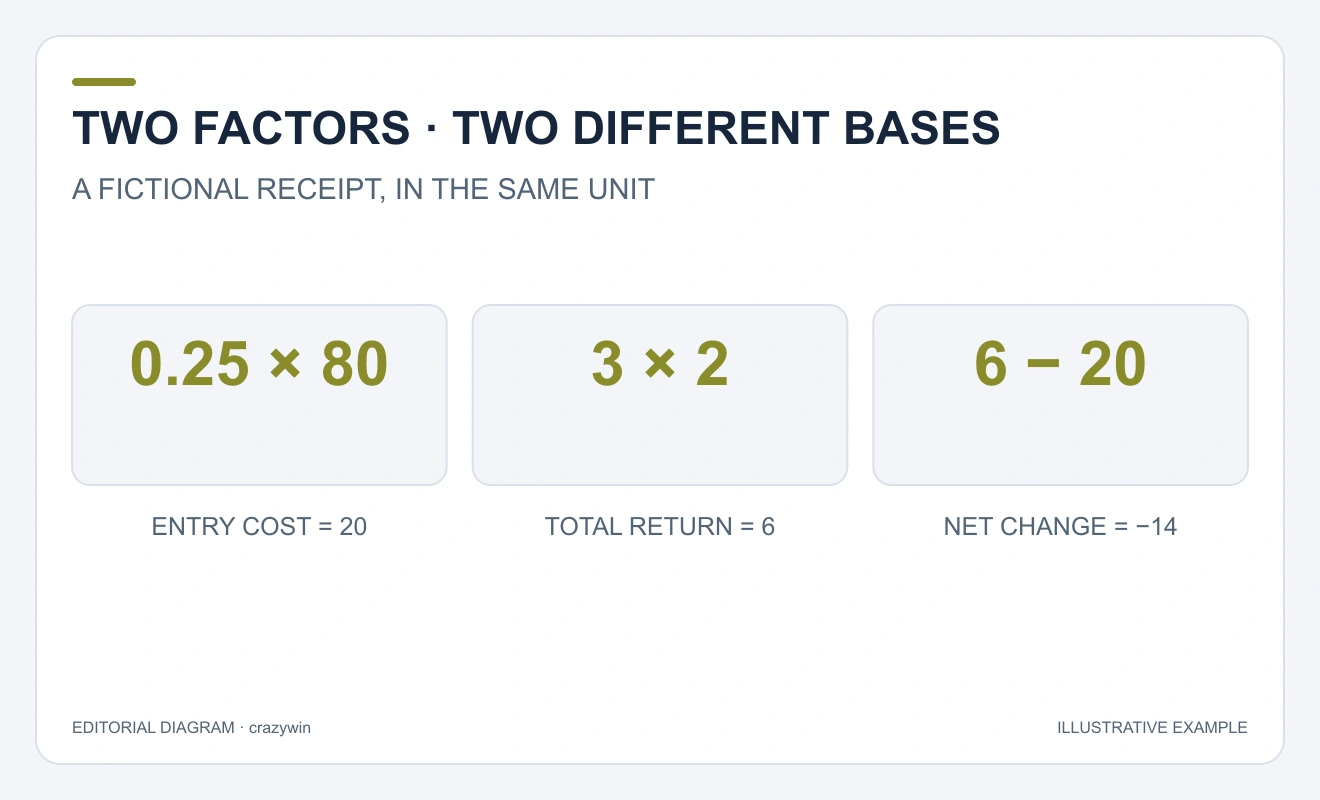
The 6-unit return is not 40 units, because the 2× factor does not apply to the 20-unit price in this model. If the feature ends with that return and no other entries, its return minus accepted cost is 6 − 20 = −14 units.
The same headline price can conceal a different cost
At a base stake of 0.50, an 80× price would be 40 units under the same fictional pricing rule. The visible factor has not changed, but the cost has doubled. An award cannot be inferred from that price change without an additional rule for awards and stake scaling.
Record the base stake, pricing factor and actual accepted cost before comparing modes. If a confirmation screen supplies a monetary price, retain that amount instead of reconstructing it from a cropped multiplier label.
Use the actual mode’s rules
The British RTS 2 transaction reference addresses clearly stated stake units. It supplies a disclosure reference, not evidence of local availability, approval or a named game’s feature price.
Rebuild the receipt, not the animation
For the completed fictional feature, begin with a balance of 100 units. The accepted entry debit of 20 takes it to 80. The final award credit of 6 takes it to 86. The independent balance check is 86 − 100 = −14, which agrees with return minus cost.
Do not subtract a separate 0.25 again if the accepted 20-unit price already includes the full entry cost. Conversely, do not assume an additional debit is included without reading its transaction label. A receipt containing 20 and 0.25 on separate lines needs an explanation of those lines before the net change can be assigned to one feature.
Keep currency, stake units and credits separate
The example uses one abstract unit throughout. A screen showing 20 credits and a wallet showing a currency amount cannot be reconciled by subtracting the two bare numbers. Record the credit denomination or conversion stated by that screen first. If 1 credit represents 0.10 of the wallet currency, 20 credits represent 2.00 in that currency; this is a unit conversion, not another win factor.
What if the entry was cancelled?
A declined confirmation is not evidence of a completed feature with a zero return. Check whether there was an accepted debit, a reversal, or no transaction at all. An accepted 20-unit debit followed by a full 20-unit reversal has a net effect of zero for those two entries. Keep it separate from the hypothetical completed feature above.
A useful receipt note is: “Entry reference __; selected stake __; accepted entry cost __; award before adjustment __; award factor and scope __; final credit __; status __.” Fill only fields the record actually supplies. A large price multiplier says nothing by itself about the return or whether buying the feature is worthwhile.