
Deposit, stakes and net loss: three different session totals
A session can contain 150 units of stakes even when only 100 units were deposited. Returned money can be staked again. That does not make the deposit 150, and it does not make the loss 150 either.
For the topic overview, see Deposit and withdrawal: current account policy prevails.
To understand an existing record, keep money added, stakes accepted and returns credited in separate totals. Combining them into one “spent” column makes both budgeting and reconciliation harder.

Follow the same money without counting it as a new deposit
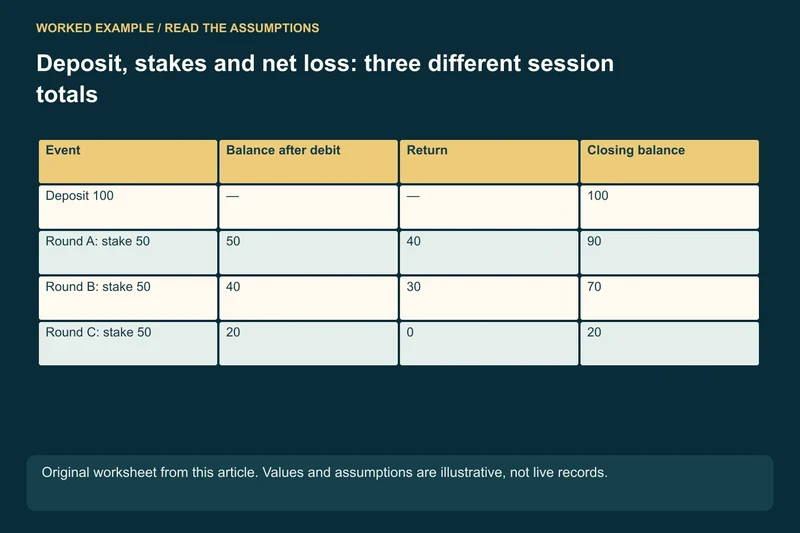
Assume an empty fictional account receives 100 units. A first round stakes 50 and returns 40. A second stakes 50 and returns 30. A third stakes 50 and returns nothing. There are no fees, bonuses, withdrawals or other transactions.
| Event | Balance after debit | Return | Closing balance |
|---|---|---|---|
| Deposit 100 | — | — | 100 |
| Round A: stake 50 | 50 | 40 | 90 |
| Round B: stake 50 | 40 | 30 | 70 |
| Round C: stake 50 | 20 | 0 | 20 |
Calculate each total from its own column
Deposits total 100. Stakes total 50 + 50 + 50 = 150. Returns total 40 + 30 + 0 = 70. Net gaming loss is 150 − 70 = 80. The account ends with 20, so the independent balance check is 100 − 80 = 20.
The extra 50 of turnover did not arrive through a secret deposit. Some returned funds passed through another round. Turnover measures repeated wagering; it is not the amount of new money added.
A limit needs the quantity and the period
The UK Gambling Commission’s financial-limit standard distinguishes deposit, spend and loss limits. That terminology is useful here, although the British requirements do not certify any Philippine account tool.
A displayed “100 limit” is incomplete until you know what it limits, the period it covers and whether it applies across the account. In the invented record, a 100-deposit total and a 150-stake total can both be correct. A loss figure needs the corresponding completed returns too.
Use the result to describe the record, not extend it
If a round remains pending, show its stake and unresolved return separately. Do not assume zero to manufacture a final loss or assume a future credit to reduce it. If an export contains both individual awards and their cumulative total, choose one representation so the same return is not counted twice.
These totals describe past activity. A difference between turnover and deposits is not spare money or a reason to continue. Once the columns reconcile, the useful conclusion is simply what was added, wagered, returned and lost during the defined period.
The crazywin homepage brings together the site’s other reading topics.
Source-based editorial research and original examples. Sources checked 9 October 2026. No real-money play or account transaction was performed for this article.